- Killings of civilians during military joint operations
- Civilians tortured to death in detention, others subjected to simulated drowning, beatings and electric shocks
- Fulani, Arabs and Tuaregs targeted
Members of Mali’s armed forces working together with personnel from the Wagner Group committed war crimes, including the murder and torture of civilians, during joint operations between 2023 and 2025, Amnesty International said in a new report.
‘No one is spared’: War crimes committed by the Malian army and foreign allied forces along the Mauritanian border documents the killings of at least 34 civilians in seven localities in Mali between June 2023 and December 2025, committed by the Malian armed forces (Forces armées maliennes – FAMa) and the Wagner Group (a Russian private military company active in Mali between late 2021 and June 2025).
The report also documents other serious violations of international humanitarian law and international human rights law, such as torture, enforced disappearance, and the pillaging and destruction of civilian property.
“Our conclusions paint a harrowing picture of the lives of civilians trapped in the conflict, paying the ultimate price while impunity remains rampant. The Malian authorities cannot dismiss these serious allegations without opening impartial and effective investigations into the alleged crimes,” said Marceau Sivieude, Amnesty International’s Regional Director for West and Central Africa.
“They must protect civilians during military operations, comply with and ensure respect for international humanitarian law, urgently clarify the chain of command under which foreign personnel act in the country, and monitor their conduct through an independent, domestic accountability mechanism.”
Unlawful killings of civilians
The report provides details of seven incidents during which 34 people were unlawfully killed in the Ségou, Mopti and Timbuktu regions.
Based on information gathered by Amnesty International, none of the victims were taking direct part in hostilities at the time of their deaths. They were deliberately shot while trying to flee or after being arrested. Some had their throats slit, others were burnt alive or post-mortem.
In Tin Adanda, a small hamlet in the Timbuktu region, four people were killed on 12 February 2025 during a joint patrol by FAMa and Wagner. Hana*, a survivor who has taken refuge in Mberra (Mauritania), lost two sons and a cousin who were arrested and then killed. Describing the members of the military operation, she said: “They were mostly white men, accompanied by FAMa.”
Drone strikes on civilians
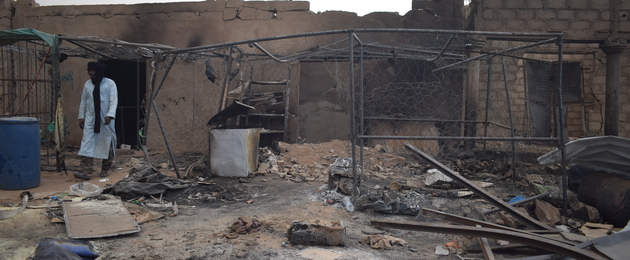
The report details two drone strikes carried out by the FAMa which targeted a market in Ejdeir (16 March 2025) and a family home in Tangata (November 2025) in the Timbuktu region, killing in total at least 23 people, including at least five children.
“We found no evidence of the presence of members of armed groups or military objectives at either drone strike site. If confirmed, these strikes would amount to direct attacks on civilians and civilian objects, and should be investigated as possible war crimes,” said Marceau Sivieude.
In Ejdeir, the drone strike hit a market without warning, during the day. On 17 March 2025, the Malian military stated that it had targeted “terrorist gatherings” in a transit camp 109km northwest of Léré, killing “11 terrorists”. According to Amnesty’s analysis, the details provided by the FAMa, particularly the location correspond to the Ejdeir drone strike.
Even if fighters or military objectives were present, attacking a market at a time when it was full of civilians in a manner that caused civilian casualties would be indiscriminate. Indiscriminate attacks that kill and injure civilians are war crimes if carried out intentionally or recklessly.
According to seven people interviewed by Amnesty International, some of whom lost relatives or were themselves injured in the attack on Ejdeir, as well as civil society organizations, there were no fighters at the market; all 16 people killed and seven injured were civilians.
“They tied our hands to the posts; our feet didn’t touch the ground”
Amnesty International interviewed 15 male survivors of torture and other ill-treatment from the Ségou, Mopti and Timbuktu regions who said they were tortured during joint FAMa – Wagner patrols or during their detention in the military bases of Léré and Nampala.
This was notably corroborated by other individuals who witnessed acts of torture committed against 30 individuals during patrols or within the two military bases. Eyewitnesses reported that five people died in the bases as a result of torture and poor detention conditions.
According to Amnesty International’s investigation, these crimes were mostly committed by members of Wagner in the presence of FAMa members, who at times served as interpreters, and who stood by and did nothing, or, in some cases even threatened detainees. Victims had their arms suspended from a metal bar, were suffocated by simulations of drowning, beaten with iron bars and sticks, or subjected to electric shocks.
Those detained and tortured in the military camps were not brought before a judge. They had no access to a lawyer or their families throughout their detention, which lasted from one day to four months.
Fulani, Arabs and Tuaregs targeted
A herder from the Ségou region who has taken refuge in Mauritania said: “In their minds [those of the soldiers and Wagner members], all herders are terrorists, and as a result they do not hesitate to burn people and property. Not even a blind person, nor even an elderly person, will be spared.”
The vast majority of the victims of these violations were members of pastoralist communities (Fulani, Arabs and Tuaregs) suspected of colluding with non-state armed groups, based solely on their ethnic background and their presence in an area where these armed groups were active.
“We urge the Malian authorities to ensure comprehensive accountability for war crimes committed against all communities. They must ensure that the FAMa, foreign military partners and members of armed groups suspected of war crimes are investigated and prosecuted as required in proceedings that comply with the right to a fair trial, without recourse to the death penalty,” said Marceau Sivieude.
“Civilians in conflict-affected regions in Mali continue to face grave risks. The authorities must protect them and make publicly available the agreement between the Government of Mali and Africa Corps, which succeeded Wagner in June 2025 and now operates in Mali. The African Union should condemn violations of international humanitarian law in Mali and support the fight against impunity for crimes under international law,” said Marceau Sivieude.
Background
This report is based on research conducted from 2025 to 2026 in ten localities in the Hodh ech-Chargui region of Mauritania where 290,000 Malian refugees were registered by UNHCR as of 31 July 2026. Amnesty International interviewed 119 refugees from the Ségou, Timbuktu and Mopti regions.
The report’s findings were shared with the Malian authorities on 3 August 2026. Amnesty International had not received a response at the time of publication.
Over the last decade, serious violations of international humanitarian and international human rights law have been committed by all parties to the non-international armed conflict between the Malian army and various non-state armed groups. Amnesty International recently reported several of these violations allegedly committed by members of the Group for the Support of Islam and Muslims (GSIM) and the Azawad Liberation Front (FLA).
Around a thousand members of the Wagner private military security company were deployed to Mali from late 2021 until June 2025. While the Malian government has denied their presence on its territory, the Russian authorities have stated that Mali had sought the support of a private company to combat insurgent fighters.
The situation in Mali has been under investigation by the International Criminal Court (ICC) since 2013. In June 2026, Mali notified its withdrawal from the Rome Statute. However, it will not affect ongoing investigations, and the ICC will maintain jurisdiction over crimes under the Rome Statute committed between January 2013 and 23 June 2027, the date the withdrawal will take effect.