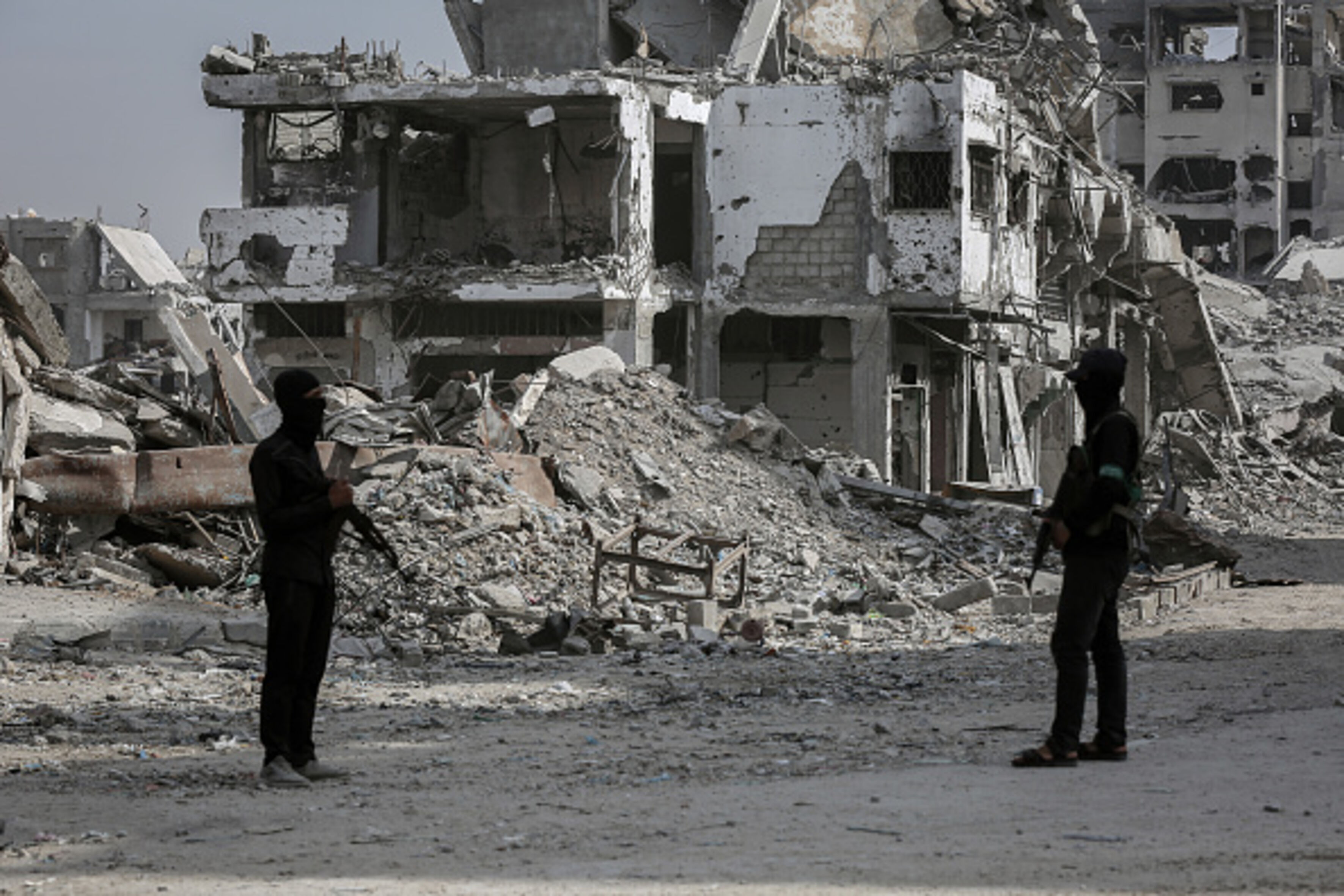
Authorities and forces affiliated with Hamas in the occupied Gaza Strip must put an end to extrajudicial executions of suspected collaborators with Israel, carried out in the absence of any judicial proceedings, Amnesty International said today. Last month alone, security officials in Hamas’ military wing, the Al-Qassam Brigades, publicly announced the summary execution of one man for collaborating with Israel and their intention to execute another “informant” within days within the context of what they called a large-scale security campaign.
A June 2026 UN report identified 249 cases of extrajudicial executions and severe physical violence in Gaza between August 2024 and early 2026, at least 60 of which involved Hamas-affiliated forces. Amnesty International has investigated and documented nine extrajudicial executions and unlawful killings by Hamas-affiliated forces committed in the immediate aftermath of the announced ceasefire between Israel and Hamas in October 2025.
While Hamas officials have said that they have opened preliminary internal investigations into the incidents, to Amnesty International’s knowledge none of those responsible for the killings have been held to account to date. In recent weeks, the collapse of law and order in Gaza , and the extreme state of deprivation caused by Israel’s ongoing genocide, has fuelled social tensions including infighting among families.
“Nearly three years into Israel’s ongoing genocide against Palestinians in the occupied Gaza Strip, the traumatized civilian population has already endured unimaginable suffering and cannot be subjected to further killings, abuses and cruelty. The Hamas authorities must immediately halt all unlawful killings, acts of vigilantism and arbitrary arrests. Restoring law and order must never serve as a cover to commit grave human rights violations, carry out reprisals, or to collectively punish entire families,” said Erika Guevara-Rosas, Amnesty International’s Senior Director for Research, Advocacy, Policy and Campaigns.
“Those responsible for ordering and carrying out extrajudicial executions as well as arbitrary arrests, torture and other ill-treatment must be held accountable. Despite its announcement of the dissolution of the governing committee that administers Gaza, Hamas remains fully responsible for preventing serious violations by its agencies and individuals under its control, including Al-Qassam Brigades and the ‘Resistance Security System’. The new leadership of the political bureau of Hamas must break with the long-standing impunity for abuses committed by its forces and its affiliates and take urgent, concrete steps to ensure truth and justice for victims and their families.”
An unidentified high-ranking member of the “Resistance Security System,” a secret security and intelligence group operating under the auspices of the military wings of Hamas and other Palestinian armed groups, also announced on the group’s official platform on Telegram, Al-Hares, that the 1 July extrajudicial execution was the beginning of a “large-scale security campaign” and that the “upcoming few days will witness the executions of others implicated with collaboration with the occupation.”
Since the beginning of the genocide, Palestinian human rights groups, including Al Mezan and the Independent Commission for Human rights, have repeatedly condemned extrajudicial executions and other unlawful killings in Gaza, including those carried out by unidentified armed groups, and have called on the authorities to investigate those responsible and ensure accountability.
A recent report by the UN Independent International Commission of Inquiry on the Occupied Palestinian Territory, including East Jerusalem, and Israel, identified 249 cases of extrajudicial executions and severe physical violence in Gaza between August 2024 and January 2026, resulting in at least 108 deaths. At least 60 of these cases involved Hamas-affiliated forces. Some of these executions were carried out in public and filmed and announced on pages affiliated with Hamas, mainly on Telegram channels.
For example, on 21 September 2025, during the height of Israel’s mass forced displacement campaign in Gaza City, a group describing itself as the “Joint Operations Room for the Resistance” claimed responsibility for the public execution in a street in Gaza City of three men accused of collaborating with Israel.
For this investigation, Amnesty International has documented nine extrajudicial executions and one unlawful killing, with all but one of these incidents taking place in the immediate aftermath of the so-called ceasefire between Israel and Hamas in October 2025. The evidence reveals how in October 2025 Hamas and its affiliated forces carried out public, summary executions of eight members of the Dughmush family from the Al-Sabra neighbourhood of Gaza City, after accusing them of collaborating with Israel. It also documented another execution on 1 July 2026.
The organization also documented the unlawful killing of a man in October 2025 during an apparent arrest operation in Al-Bureij refugee camp near Salaheddine street by masked armed gunmen.
Amnesty International verified photos and videos, gathered testimonies from 11 family members of people killed and two health workers, and analysed statements by Hamas authorities and Telegram accounts of its military wing and affiliated armed groups.
Amnesty International shared a summary of its findings with Hamas leadership in November 2025 and sent a follow-up inquiry in July this year. In its November 2025 response, the Hamas authorities stated that they had opened investigations into the incidents, without disclosing more details. No response had been received at the time of publication this year.
Since 7 October 2023, Hamas forces and authorities in Gaza have established parallel forces acting almost entirely outside any legal norms, regularly carrying out – and often filming – summary punishments against Palestinians, including alleged looters, interrogating dissidents and criminal suspects in civilian locations, raiding civilian homes, and threatening family members of their opponents. Evidence collected by Amnesty International is consistent with the findings of the UN Commission of Inquiry’s report.
Hamas has justified what it has called “exceptional measures” by invoking the “principle of state of necessity,” citing the destruction of judicial and security institutions by Israeli forces and the need to address chaos and “criminal gangs.”
“Unlawful killings can never be justified. The rights to life, freedom from torture and a fair trial and due process must be respected at all times, including in emergency situations or even where the judicial system has collapsed as a result of active military hostilities. Anyone suspected of a criminal offence, including treason or collaboration, must be afforded full respect for human rights, including the rights to life, security of person, and to a fair trial, without resort to the death penalty,” said Erika Guevara-Rosas.
July 2026 summary executions
On 1 July, the “Resistance Security” announced the public execution of a man in Gaza City, referred to by his initials, accusing him of collaborating with Israel. After his execution, the man’s full name and details were circulated on social media, initially by accounts affiliated with Hamas, putting his family, including his children, at great risk, in a pattern known as doxxing.
The man was accused of informing Israeli forces of the location of High-ranking members of Al-Qassam Brigades, including its military commander Ezziddine al-Haddad. He was accused by the group of handing the Israeli authorities information that led to Israel’s killing of Ezziddine Al-Haddad as well as numerous Palestinian civilians. The group claimed that it has carried out the execution after exhausting what it called “revolutionary procedures” and internal investigations.
Days later, Telegram channels associated with the Al-Qassam Brigades announced that the “Resistance Security” had arrested and interrogated another alleged informant, without disclosing further details, and intended to execute him “within days.”
This statement came following a claim by a “Resistance Security” official that the 1 July execution would be the beginning, raising concerns that others summary executions may follow.
Extrajudicial executions of eight members of the Dughmush family
In October 2025, clashes between Hamas and members of the Dughmush family broke out around 10 October 2025, just after the ceasefire with Israel was announced. They began when Hamas affiliated forces tried to remove members of the family from a field hospital near Al-Sabra, Gaza City where they had sought shelter from Israeli strikes, accusing them of looting the hospital and using it to store weapons and explosives.
During armed clashes with armed members of the Dughmush family, Hamas forces encircled the family’s quarter in Al-Sabra for a week, and at least four members of the Dughmush family and at least one Hamas member, were killed. During the siege on Al-Sabra, Hamas forces and their affiliates also looted, burned and vandalized homes in the area. Amnesty International received footage of two homes in the neighbourhood that showed the aftermath of the damage and looting.
In parallel to the clashes, on 13 October 2025, eight unarmed members of the Dughmush family were extrajudicially executed in public on allegations of collaborating with Israel.
A video circulated on Hamas-affiliated social media accounts and verified by Amnesty International shows eight blindfolded and shackled men, some of whom were only partially dressed and appear to show signs of prior injuries, being dragged by armed masked men into an open space in Al-Thalathini street, a major street in Gaza City. The eight men were shot dead at close range.
Among the eight men extrajudicially killed were the relatives of a Palestinian woman who spoke with Amnesty International and whose name is withheld for protection.
“The eight men had turned themselves in after being promised a fair trial, only to be publicly executed two hours later,” she said.
Her account was consistent with information provided to Amnesty International by two other residents who were interviewed separately and who said that the decision to turn the eight men in was taken to bring an end to the fighting, after guarantees that they would not be harmed.
The wife of one of the victims reported that her husband had called her the night before his killing, asking her to look after their daughters. She said:
“Both my husband and son were executed. My son was tortured before his execution, and his nails were broken… My husband was a kind, honourable man who always resisted the Israeli occupation … I want everybody to know that our family are not collaborators and those who ordered their killing should be brought before justice.”
Family members who attended the burial of the eight victims told Amnesty International that the victims’ bodies bore visible signs of torture.
Some family members later reported that they had received calls from Hamas officials apologizing and suggesting some individuals were killed by mistake.
In their response to Amnesty International, the Head of Hamas International and Legal Relations Department, Dr Mousa Abu Marzouk, stated that they had opened an internal preliminary investigation into the Dughmush family incident, asserting that the security forces had acted as an “immediate reaction without referring to higher authorities.”
To the organization’s knowledge, none of those involved in the killings, or any other extrajudicial executions over the past three years, has been investigated, let alone held accountable. That includes killings of civilians by armed men affiliated with Hamas following “mistaken identity.”
One notable case is the killing of Islam Hijazi, a Palestinian aid worker, after her car was hit by 90 bullets in Khan Younis in September 2024. Her family was later told that her killing was the result of mistaken identification, but to the organization’s knowledge none of those responsible for firing the bullets or ordering the ambush was investigated.
Unlawful killing of Hisham al-Saftawi
Amnesty International also documented the unlawful killing of Hisham al-Saftawi, 57, in Al-Bureij Refugee camp on 17 October 2025. His wife, Najah, witnessed approximately 30 masked armed men, who identified themselves as being from the Al-Qassam Brigades, storming their home shortly after dawn prayers. When Hisham al-Saftawi refused to comply with the arrest order, one of the men shot him in the back.
Najah heard a man who looked like the commander of the group ask the shooter: “Who ordered you to shoot?” Hisham al-Saftawi succumbed to his wounds in the hospital a day later.
His brother, Said al-Saftawi, expressed the family’s lack of faith in the Hamas-run investigation: “You cannot trust the executioner to investigate itself. We call for an independent investigation and for those who shot my brother and those who ordered his arrest to be held accountable.”
In its response to Amnesty International, Hamas confirmed an official investigation into the killing of Hisham al-Saftawi, claiming he had been “accidentally shot“ while attempting to flee and was wanted for criminal offences. To the organization’s knowledge, Hamas authorities have not informed the family of the results of its alleged investigation and none of those involved in the killing of Hisham al-Saftawi were held accountable. Hamas authorities have not indicated that they would consider providing reparation for the killing.
“There must be independent and impartial investigations into all the killings that took place in the context of the armed confrontation between Hamas and the Dughmush family, including killings that appear to have been committed outside any exchange of fire, as well as the public execution of the eight Dughmush family members. The family of Hisham al-Saftawi must also see justice for the unlawful killing of their relative,” said Erika Guevara-Rosas.
Background
Since 7 October 2023, Israel has imposed conditions of life on Palestinians in the Gaza Strip that have contributed to the dismantling of law and order, the shredding of Gaza’s social fabric and the rise of chaos and lawlessness. Israeli forces targeted traditional law-enforcement and judicial structures and apparently targeted police and security officers – whilst also arming and backing local militias opposed to Hamas, which operate in areas where Israeli forces are fully deployed. These militias have also engaged in abuses and violations of international law, including execution-style public killings of alleged Hamas operatives.
Since taking over the Gaza Strip in 2007, Hamas authorities have failed to independently investigate alleged violations and wrongdoings by their members and forces. Until the beginning of Israel’s genocide, courts in Gaza under the authority of Hamas continued to issue and execute death sentences for crimes, including murder, collaboration and treason, often following deeply flawed trials.
During and in the wake of past Israeli offensives on the occupied Gaza Strip, Hamas-affiliated forces also repeatedly resorted to public summary executions of alleged collaborators outside any judicial framework and with total impunity, including in cases documented by Amnesty International during the 2014 offensive.
Amnesty International has documented violations by Hamas and its affiliates over many years, including extrajudicial executions of alleged collaborators, summary punishments, restrictions on freedom of expression, and crackdowns on peaceful dissent, including through threats, doxxing, intimidation, and torture and other ill-treatment.
As Amnesty International continues to document these violations, it reiterates its calls on Israel to end its ongoing genocide, apartheid and unlawful occupation of Palestinian territory and to uphold its obligations as the occupying power, including by ensuring aid, essential goods and services can reach all parts of the Gaza Strip, and allowing displaced Palestinians to safely return to their homes.