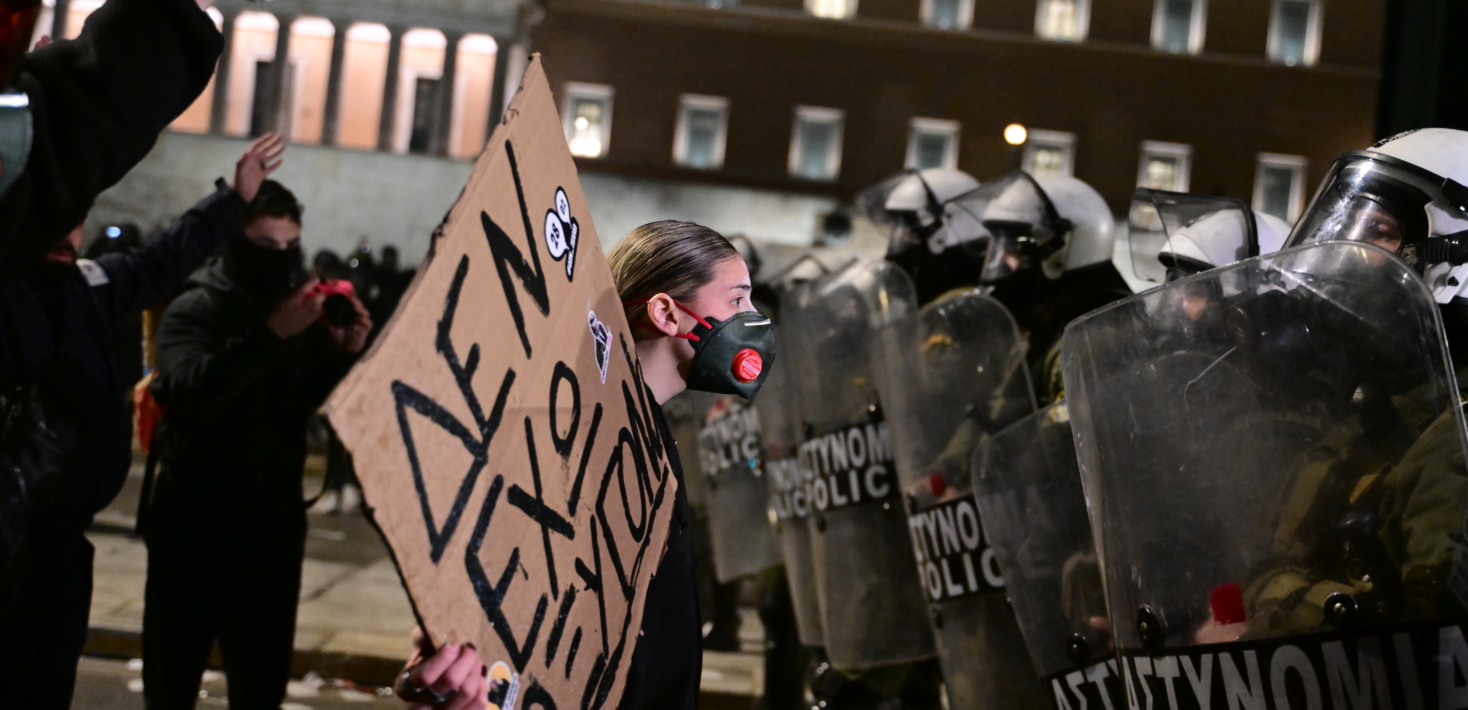
Greek police frequently use unnecessary or excessive force against peaceful protesters and journalists resulting in serious physical and psychological injuries, Amnesty International said in a report published today, as it called for a ban on the use of stun grenades in the policing of protests.
Protests are not battlefields: Patterns of unlawful use of force by police and impunity in Greece finds that these deeply disturbing abuses are underpinned by protest legislation that fails to comply with international and regional standards, and a persistent culture of impunity for abuses by law enforcement officials policing demonstrations.
“The right to freedom of peaceful assembly in Greece is being blatantly violated both in law and in practice with peaceful protesters arbitrarily detained, criminalized, and subjected to unlawful use of force at the hands of the police,” said Kondylia Gogou, Amnesty International’s Regional Researcher for Europe.
“The footage and testimonies we have documented reveals a pattern of dangerous deployment of stun grenades and misuse of batons and other less lethal weapons that have caused a range of injuries, with journalists also in the firing line. These tactics, combined with pervasive impunity for police abuses, have a chilling effect on the right to peaceful protest.”
Unlawful use of force and a culture of impunity
The report, based on two years of research and interviews with more than a hundred protesters, journalists, lawyers and others as well as extensive video verification and analysis of multiple different protests, reveals a persistent pattern of unnecessary or excessive use of force by police during demonstrations.
Of the 67 people interviewed in relation to unlawful use of force in the policing of demonstrations, 30 described how police threw stun grenades directly at peaceful protesters and journalists, above their heads or at their feet and/or into dense crowds.
Photojournalist Marios Lolos, sustained hearing loss and a head injury after being hit by a stun grenade thrown by a police officer on 26 January 2025 while covering a demonstration about the Tempi rail tragedy. He told Amnesty International: “I was carrying my camera, and it was obvious that I was a journalist. I believe the riot police officer threw the stun grenade at me intentionally…It hit the left side of (my head) and exploded next to me. If it had exploded in front of my head and not a little bit later, we would not be speaking at the moment.” A video verified by Amnesty International corroborates Lolos’ testimony and suggests that he was deliberately targeted. In May 2022, student Giorgos Mavros suffered a perforated eardrum, hearing loss, a head injury and wounds and burns on his right hand, arm and shoulder after police deployed stun grenades during a peaceful student demonstration in Thessaloniki. He said: “The sensation was as if I had been struck by a large iron bar.”
Verified video shows police unlawfully using stun grenades next to a café where people were sitting outside following the dispersal of an October 2025 protest in Athens, with bystanders caught up in the chaos. The report also documents unlawful use of batons, including officers striking peaceful demonstrators, chasing protesters in so-called “baton charges”, and beating individuals who were already under police control. Amnesty International additionally documented a series of incidents involving misuse of chemical irritants, water cannon, unlawful use of force during arrest and/or detention and unlawful use of force by police motorbike units.
Actress and theatre director, Anastasia Politi, described to Amnesty International how two police officers on a motorcycle, one of them holding a baton, drove through a crowd attending a demonstration in a solidarity with Palestinians on 7 October 2025.
“I managed to step onto the pavement at the very last moment so the motorcycle wouldn’t run me over…but I still felt the bike passing extremely close behind me and at the same time a very strong blow to my back,” she said. She described how she “hit the ground like a watermelon” resulting in bruising, a broken arm, and a broken rib, light head injuries and injuries to her left knee and shin.
Victims of unlawful use of police force often struggle to get justice. Flawed disciplinary investigations, criminal investigations unable to find perpetrators, some judicial rulings that risk legitimizing unlawful force and failure of public order police to display identification numbers hamper accountability. Meanwhile, Greece’s police oversight mechanism (EMIDIPA), does not have sufficient staff and resources to conduct more of its own investigations.
Broad police powers, draconian tactics and restrictive laws
The use of overly broad police powers allowing police to stop protesters and bring them to police stations for identity checks has resulted in people being prevented from joining demonstrations, often without reasonable suspicion of wrongdoing.
Protesters, journalists and lawyers speaking with Amnesty International were subjected to arbitrary deprivation of liberty and described unnecessary and/or degarding body searches, unlawful use of force during their apprehension and/ or detention and denial of medical assistance. They also spoke of police failure to guarantee their right to notify someone in the outside world or provide them with sustenance.
Anny Paparoussou, a lawyer providing legal assistance to peaceful protesters and Marina Meintani, a journalist covering a demonstration, were both deprived of their liberty by police under the guise of an ID check transfer. Both Anny Paparousou and Marina Meintani spoke about the unlawfulness of their apprehension and Marina Meintani of her humiliation at being partially strip searched by police.
The report also highlights the criminalization of peaceful protesters, including individuals charged simply for participating in demonstrations or engaging in acts of civil disobedience. Amnesty International documented the arrest of two of its own activists following the dispersal of a protest in Athens in 2022, during which they described experiencing being subject to unnecessary and abusive force by police.
Greek legislation governing protests is not compliant with international and regional human rights law and the obligations Greece has under the treaties to which it is party. Nevertheless, there have been efforts by the Greek authorities to further restrict the right to freedom of peaceful assembly including a 2025 legislative provision introducing a blanket ban on protests in parts of Syntagma Square.
“Participating in or reporting on peaceful protests should not require people to run a gauntlet or risk life and limb. Greek authorities must urgently reform protest laws, end abusive policing practices, protect those exercising their rights and break the cycle of impunity that has allowed these violations to continue,” said Kondylia Gogou.
“Greek authorities must also end the disturbing pattern of unlawful use of force against protesters and journalists by the police and ban the use of stun grenades in the policing of assemblies. Military-grade devices have no place in policing protests in Greece or anywhere in the world.”
Background
According to the NGO Greek Helsinki Monitor, prosecutors investigated 181 cases concerning human rights violations and other serious offences by law enforcement officials between 2019 and November 2025, yet there were only seven convictions. Of the 60 cases investigated for allegations of torture committed by law enforcement officials over the same period only four were referred to trial and there was only one conviction.
Amnesty International and civil society partners from the Torture-Free Trade Network are calling on governments all over the world to push for a Torture-Free Trade Treaty at the United Nations to regulate the trade in policing equipment.
Amnesty has been documenting and raising concerns around the policing of protests in Greece for many years, including in these 2021 and 2012 reports.