Sweeping arbitrary detentions, enforced disappearances, bans on gatherings and attacks to silence families of victims mark the suffocating militarization imposed in Iran by the Islamic Republic’s authorities in the aftermath of protest massacres, Amnesty International said today.
Since 8-9 January 2026, when the Iranian authorities committed mass unlawful killings on an unprecedented scale to crush the popular uprising calling for an end to their repressive rule, they have waged a coordinated, militarized clampdown to prevent further dissent and hide their crimes.
The nationwide repression has involved maintaining a complete internet blackout, deploying heavily armed security patrols, imposing nighttime curfews and preventing any gatherings. Security forces have also arrested thousands of protesters and other dissidents, and subjected detainees to enforced disappearance and torture and other ill‑treatment, including sexual violence. Authorities have further relentlessly and cruelly harassed and intimidated bereaved families of killed protesters.
“While people in Iran are still reeling from the grief and shock of the unprecedented massacres during protest dispersals, the Iranian authorities are waging a coordinated attack on the rights of people in Iran to life, dignity and fundamental freedoms in a criminal bid to terrorize the population into silence.
“Through the ongoing internet shutdown, the authorities are deliberately isolating over 90 million people from the rest of the world to conceal their crimes and evade accountability,” said Diana Eltahawy, Deputy Regional Director for the Middle East and North Africa at Amnesty International.
“The international community must not allow another chapter of mass atrocities in Iran to be buried without consequence. Urgent international action, including steps towards accountability through independent international justice mechanisms, is long overdue to break the cycle of bloodshed and impunity.”
On 21 January 2026, Iran’s Supreme Council of National Security issued a statement that 3,117 people were killed during the uprising. However, on 16 January 2026, the UN Special Rapporteur on Iran, Mai Sato, said in a media interview that at least 5,000 people had been killed.
Given the gravity of the situation, a Special Session on the human rights situation in Iran is taking place today at the UN Human Rights Council. In a briefing circulated to diplomats in Geneva on 19 January 2026, Iran’s Permanent Representative sought to portray the protests as a foreign-engineered “security threat” in an attempt to avoid international scrutiny. The briefing also falsely claimed that the authorities have “refrained from adopting a broad or indiscriminate hard-security approach” in the aftermath of the uprising, justifying the sweeping internet shutdown as a “public safety” measure.
Amnesty International calls on the Iranian authorities to immediately restore internet access; release all those arbitrarily detained; disclose the fate and whereabouts of all those subjected to enforced disappearance; protect all detainees from torture and other ill-treatment; and grant detainees access to their lawyers, families and any medical care they require. Authorities must also stop the intimidation and harassment of victims’ families.
The information blackout imposed by the Iranian authorities since 8 January 2026 has severely obstructed in-depth documentation of human rights violations. Further, crucial evidence, including videos and photographs recorded on mobile phones, has been lost when security forces confiscated devices from those unlawfully killed or arbitrarily detained.
Despite this, for this press release, Amnesty International was able to speak to a human rights defender and a medical worker in Iran and 13 informed sources outside Iran, including relatives of victims unlawfully killed or detained, human rights defenders and journalists with information about violations in the provinces of Alborz, Chaharmahal and Bakhtiari, Esfahan, Gilan, Ilam, Kermanshah, Kurdistan, Razavi Khorasan, Tehran, and West Azerbaijan. Amnesty International also analyzed videos published online of the militarized clampdown in Iran and reviewed official statements and reports from independent Iranian human rights organizations.
Mass arbitrary arrests and enforced disappearances
According to reports from state-affiliated media published on 16 January 2026, the authorities have arrested thousands of people in relation to the protests. Independent reports and other information received by Amnesty International indicate that tens of thousands of people, including children, have been arbitrarily detained.
The Iranian authorities have carried out sweeping arrests across the country in recent days, seizing people during night‑time home raids, at checkpoints, in workplaces, and from hospitals. In addition to protesters, among those arrested are university students and schoolchildren, human rights defenders, lawyers, journalists, and members of ethnic and religious minorities.
Amnesty International has received distressing reports indicating that security forces arrested protesters receiving treatment in hospitals. A human rights defender in Iran told Amnesty International that security forces in Esfahan province instructed medical staff in hospitals to notify them about patients with injuries sustained from gunshots and metal pellets. Two informed sources told the organization that security forces in Esfahan and Chaharmahal and Bakhtiari provinces arrested wounded protesters from hospitals, including, those needing life-saving medical care. Given well-documented patterns of torture and other ill-treatment during past protest crackdowns, there are serious concerns that security forces will deny adequate medical care to injured protesters removed from hospitals, increasing the risk of deaths in custody.
According to information received by Amnesty International, security forces have threatened medical staff in Esfahan province with prosecution and other harm for treating injured protesters without notifying the authorities.
Detainees’ families, activists and journalists have told Amnesty International that the authorities are routinely refusing to provide any information about the fate and whereabouts of many of those detained, thereby subjecting them to enforced disappearance, a crime under international law. Some detainees have been taken to prisons and other official places of detention, while others are being held in military barracks, warehouses or other makeshift places of detention without official registration, placing them at heightened risk of torture and other ill-treatment.
Informed sources report that security forces have subjected detainees to torture and other ill-treatment during arrest and in detention, including through beatings, sexual violence, threats of summary executions, and deliberate denial of adequate food, water and medical care.
In one case documented by the organization, security forces raided the family home of a protester, Amirhossein Ghaderzadeh, in Rasht, Gilan province, on 9 January 2026 and arrested him. Agents stripped him and his two sisters, one of whom is a 14-year-old child, naked to inspect their bodies for metal pellets to “prove” their participation in protests. Since then, the authorities have refused to disclose his fate and whereabouts to his family, thereby subjecting him to enforced disappearance.
Amnesty International has received reports from informed sources that, amid the systemic denial of access to lawyers, authorities are forcing detainees to sign statements they have not been allowed to read and to give forced “confessions” to crimes they did not commit as well as to peaceful acts of dissent.
In recent days, state media has broadcast dozens of propaganda videos showing detainees “confessing” to peaceful acts such as sending protest images to media outside Iran, as well as to violent acts including vandalism and arson. The Iranian authorities have a long history of broadcasting torture-tainted forced “confessions” to shape public opinion and pave the way for harsh sentences, including the death penalty.
Amid a climate of systemic impunity granted to security forces, Amnesty International is gravely concerned about the recurrence of previously documented patterns of torture and other ill-treatment against detained protesters, including beatings, floggings, electric shocks, mock executions, suspension from the wrist or neck, rape and other forms of sexual violence.
Public statements by senior officials labelling protesters as “terrorists” and “criminals” have compounded fears of further arrests and expedited grossly unfair show trials leading to arbitrary executions.
Since 10 January 2026, the Prosecutor General of Iran and provincial prosecutors have publicly described protesters as mohareb (“an individual accused of waging war against God”), which carries the death penalty in Iran.
On 19 January 2026, the Head of the Judiciary, Gholamhossein Mohseni-Eje’i, ordered for rapid prosecutions and “deterrent” punishments. Two days later, he publicly boasted about ordering harsher charges against arrested protesters than those levelled by prosecutors. In a flagrant violation of fair trial rights, he has also interrogated protesters without lawyers present in coerced “confessions” broadcast on state media.
Intimidation of victims’ families
Families of those killed or detained have been subjected to a systematic campaign of intimidation and coercion.
Authorities have pressured relatives into holding burials in the middle of the night in the presence of security forces. Amnesty International has received information from a medical worker who said that in Mashhad, Razavi Khorasan province, security forces conducted mass burials without notifying the families of those killed.
According to information gathered by Amnesty International, following the massacres on 8-9 January 2026, many relatives were told that the bodies of their loved ones would be withheld unless they paid extortionate sums of money, signed pledges or made public statements falsely declaring that their deceased relatives were members of the Islamic Revolutionary Guards Corps’ Basij battalions, rather than protesters, and blaming their deaths on “terrorists”.
The relative of a woman killed in Tehran province sent Amnesty International screenshots of a conversation with a family member in Iran, who wrote:
“They [authorities] have committed atrocities here. Security forces shot […] and she bled to death because she didn’t receive any medical care… When someone is killed, they don’t easily hand over the body to the family. If the family wants to claim the body, they should write that the person was from the Basij and that they were killed by protesters.”
An informed source told the organization that he knows of at least one victim killed in Tehran province on 8 January 2026 whose family has not been able to recover their relative’s body more than two weeks after his death because they are unable to afford the sum demanded by the authorities.
The authorities have broadcast statements from several grieving families forced to support false state narratives about the unlawful killing of their loved ones. In one case involving the unlawful killing of a two-year-old child who was shot in the head in Neyshabur, Razavi Khorasan province, on 9 January 2026, state media broadcast several propaganda videos seeking to absolve the security forces of responsibility and blame her killing on “terrorists”. One video shows a statement from her father in which an off-camera voice can be heard prompting him on what to say, with the father repeating verbatim. The authorities have not released the child’s full name but reported her first name as “Bahar”.
Amnesty International has learned that many families are still searching for missing loved ones, as the authorities continue to deny them any information about whether their loved ones have been killed or are held in detention.
Militarized environment causing suffocating repression
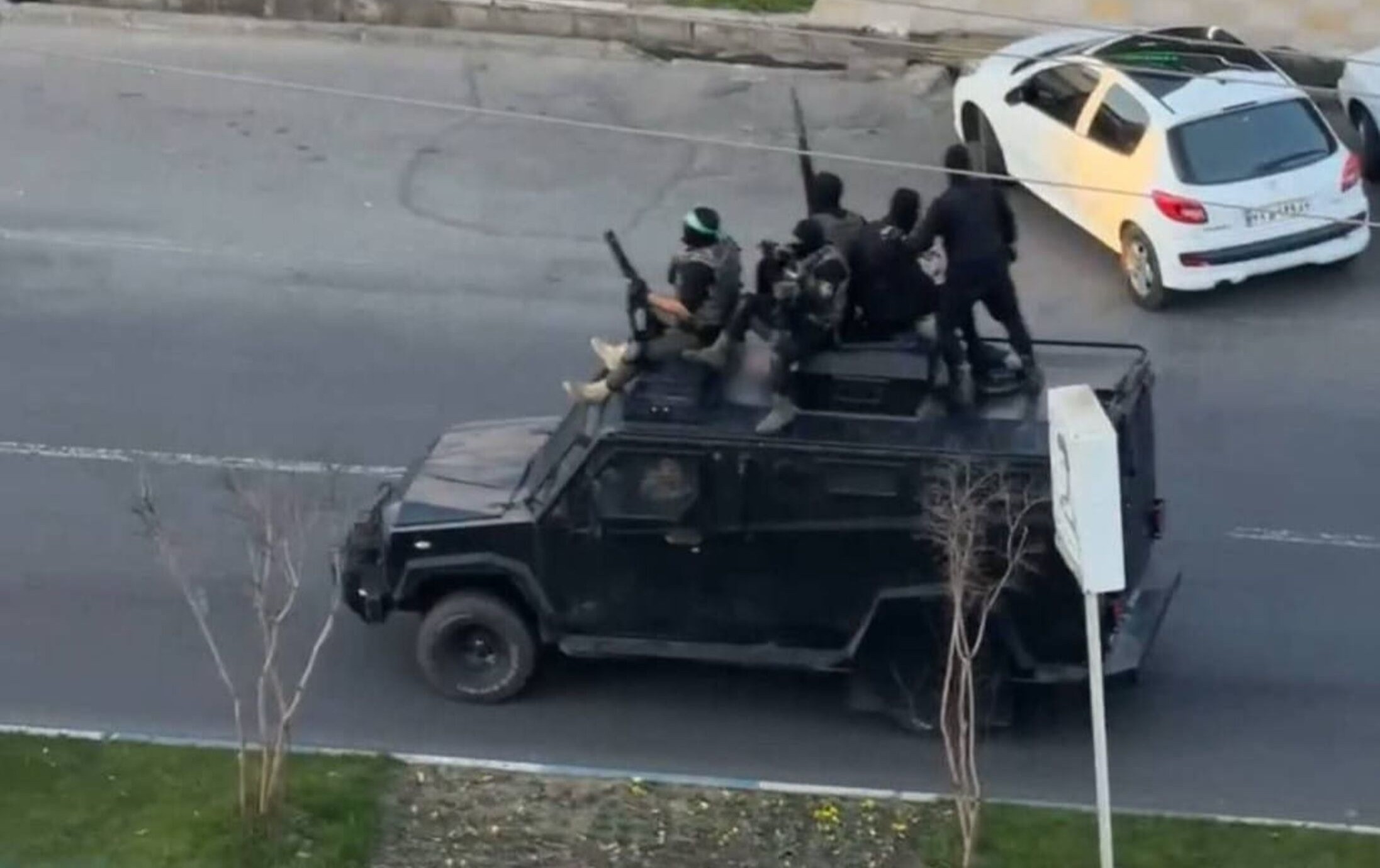
Since 9 January 2026, the authorities have imposed sweeping military-style control measures across the country. Heavily armed units of security forces have been deployed nationwide, erecting dense networks of checkpoints and armed patrols across cities and inter-city roads.
Security forces routinely stop people’s cars arbitrarily and conduct vehicle and mobile phone searches. Informed sources have told the organization that the authorities have restricted freedom of movement and enforced nighttime curfews. From dusk onwards, security forces order people through loudspeakers to return to their homes and stay there. Such patrols warn that street gatherings of two or more people are prohibited and will result in arrests.
Amnesty International analysed videos published online which support eyewitness accounts of the militarization. A video from Mashhad, Razavi Khorasan province, posted on 15 January 2026, shows security forces patrolling Hashemiyeh and Vakil Abad boulevards on foot and vehicles.
Another video from Borujerd, Lorestan province, published online on 17 January 2026, shows armed security forces in beige camouflage uniforms, equipped with lethal firearms, and vehicles along Takhti Boulevard. The video shows tank trucks and what appear to be repurposed civilian trucks mounted with large nozzles, likely to be used as water cannons.
A third video posted on 15 January 2026 from Tonekabon (Shahsavar), Mazandaran province, shows dozens of security forces vehicles, including motorcycles and an armoured personnel carrier, transporting agents through Shiroudi Boulevard.
Other videos show security forces taunting residents to create an intimidating atmosphere. A video published online on 20 January 2026 shows armed security forces with their faces covered, patrolling streets in residential areas in pick‑up trucks mounted with heavy machine guns and repeatedly ordering residents to “go inside” while chanting phrases hailing the Supreme Leader. Amnesty International was unable to independently verify the location where this footage was recorded.