• Strike on Ramat Lehi neighbourhood destroyed Tiferet Israel synagogue
• New investigation shows no military objective in vicinity of strike
• “The weapon used in the strike is wildly inaccurate” – Erika Guevara-Rosas
A missile strike by the Islamic Republic of Iran’s authorities on the Israeli city of Beit Shemesh that killed nine civilians – including four teenagers – must be investigated as a war crime, Amnesty International said in a new investigation.
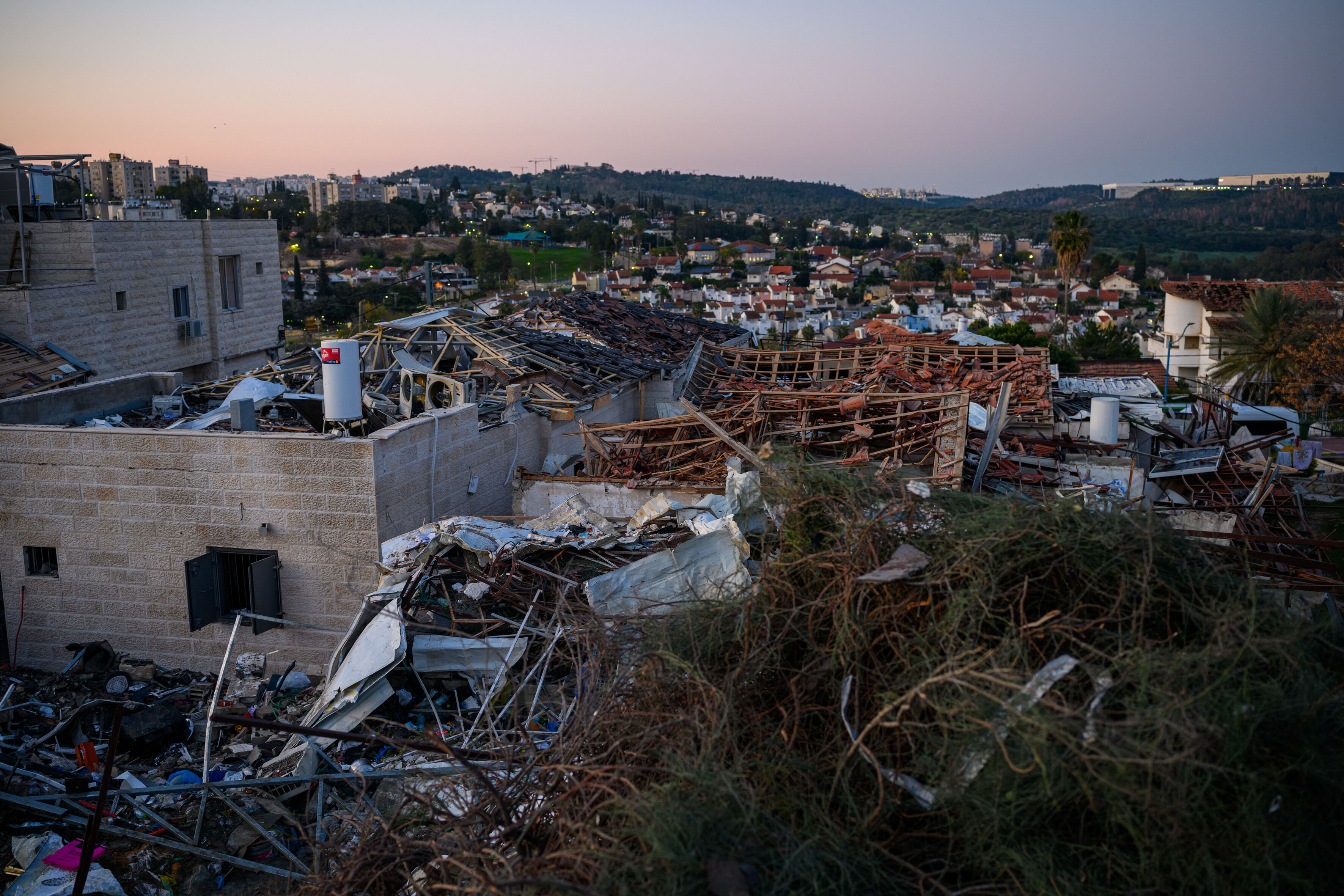
The strike, just before 2pm local time on 1 March on the Ramat Lehi neighbourhood, destroyed the Tiferet Israel synagogue and caused extensive damage to the bomb shelter beneath it. An estimated 46 people were also injured.
Amnesty International analysed verified digital evidence posted on social media, along with photos and videos the organization collected from the site of the strike, and found that an Iranian ballistic missile was used in the attack.
“The weapon used in Iran’s strike on the Ramat Lehi neighbourhood in Israel is wildly inaccurate and carries a massive warhead, making it completely inappropriate for use in densely populated civilian areas,” said Erika Guevara-Rosas, Amnesty International’s Senior Director of Research, Advocacy, Policy and Campaigns.
Amnesty International’s research found no evidence of the presence of legitimate military objectives in the immediate vicinity of the attack. The nearest military objective to the site of the strike appears to be an Israeli military base near the town of Sdot Micha, which is located approximately 3.5km to the west of the impact site.
“This attack destroyed a synagogue and a bomb shelter – two places that should have been areas of refuge and safety for civilians. Nine civilians were killed, including four children. The strike must be investigated as a war crime,” said Erika Guevara-Rosas.
“The Iranian authorities’ use of a ballistic missile in this attack renders it indiscriminate and therefore a violation of international humanitarian law. Launching an indiscriminate attack that causes civilian deaths, injuries or damage to civilian objects constitutes a war crime. There must be an independent and impartial investigation, and anyone for whom there is sufficient evidence of responsibility must be prosecuted in a fair trial.”
Amnesty International verified social media footage showing the munition falling in the city of Beit Shemesh. The trajectory of the munition and the extent of the damage at the scene of the strike are consistent with the use of a ballistic missile carrying a large warhead, rather than a cruise missile or smaller drone-delivered munition. Images from the aftermath show the razed synagogue, along with widespread damage across an approximate 500-metre radius.
Israeli media outlets reported that the warhead used was approximately 500 kg. Amnesty International has not been able to confirm the payload of the weapon. A 2024 analysis of the accuracy of Iranian ballistic missiles found they routinely missed their target by at least half-a-kilometre.
Between 16 March and 19 March, Amnesty International interviewed four survivors of the attack, and a rescue worker who arrived soon after the strike. The organization also analyzed satellite imagery of the site before and after the attack to corroborate the scale of destruction.
“We are all in despair. We are broken”
Nine civilians were killed as a result of the strike: siblings Sara Biton, aged 13, Avigail Biton, 15, and Yaakov Biton, 17; Gabriel Revah, 16; Oren Katz, 46; Sara Elimelech, 67, and her daughter, Ronit Elimelech, 45; and Bruria Cohen, 76, and her son, Yossi Cohen, 41.
Rabbi Yitzak Biton lost three of his children in the attack. On the morning of the attack, he gave a lesson to Torah students. His two daughters, Sara and Avigail, convinced his son Yaakov to go to the nearby bomb shelter with them, while he, his wife Tamar, and his four-year-old daughter Rachel stayed at their house, located one block from the synagogue.
He told Amnesty International: “The ceiling and the roof [of their house] collapsed… I looked through the window, and I saw the area where the synagogue was. It was on fire, and there was very black smoke in the sky. I was afraid to go… After I worked up the courage to go, I saw the synagogue was completely destroyed, and the [bomb] shelter was split open. The shelter wasn’t safe. It did not provide protection.
“I lost not one, not two, but three children… One day, out of the blue, half of the family is gone.”
Sarah Fanny Amar, 53, was in the bomb shelter when the strike hit the synagogue. She told Amnesty International: “There was a big boom… I was hanging from metal, and metal was on top of me. Before the boom I was sitting, so the shockwave had thrown me. Around me everything was black and dust… The ceiling collapsed on top of me… I started walking, but I could barely see anything, and I was feeling my way with my hands. I was walking on top of ruins and people… Outside, there was fire… Cars were burning… I got to the grass, and that’s where I collapsed. I opened my eyes in an ambulance.
“With these bombs, you’re left with no desire to live, to sleep, to eat… I can’t live like this… Even in the shelter you are not safe… I knew everyone who was killed.”
Nissim Edery, 71, was sitting with his neighbour about 100m from the site of the attack. He told Amnesty International: “At the moment of the explosion, I was thrown 4-5m from the shockwave… I realized it was a missile that hit our area… I walked toward the explosion, and there was a huge fire and smoke… It was unbelievable to see what destruction this missile made.
“I know three of the victims, a brother and his two sisters. It tore my heart… We are all in despair. We are broken.”
Reuven Harow, 56, is a senior medic for the emergency medical service Magen David Adom. He arrived at the site around 10 minutes after the attack. He told Amnesty International: “People were coming out all bloodied and bruised… No one knew where the missile strike was – there was damage everywhere…
“Bodies were blown apart… There were body parts lying around for hours after. The focus was on saving anyone who was alive… The people who were giving treatment at the scene – they were treating family and family friends they had known for years. Everyone knows everyone here… What I kept saying over and over is ‘This isn’t real’… It looked like I was watching a movie.”
Background
On 28 February, the US and Israel launched joint attacks on Iran, with thousands of strikes across the country since. The Iranian authorities have launched retaliatory attacks across the region. The armed conflict rapidly expanded into regional hostilities across the Middle East and has resulted in significant loss of civilian life and destruction of civilian infrastructure. Israel has also escalated its attacks on Lebanon in response to Hezbollah’s attacks.
According to various media sources, Iranian forces have used cluster munitions in multiple attacks in Israel since 28 February, including on 18 March, in an attack near Tel Aviv that killed two civilians. Cluster munitions are inherently indiscriminate weapons, and their use is prohibited by international humanitarian law. Last year, Amnesty International documented how Iranian forces’ use of cluster munitions in the ‘12 Day War’ with Israel violated international humanitarian law.
As of 27 March, according to reports, as a result of Israeli and US attacks, at least 1,900 people, including at least 100 Minab schoolchildren, have been killed in Iran; more than 1,116 in Lebanon. Iranian attacks have thus far killed at least 16 civilians in Israel and four in the occupied West Bank; and at least 23 killed across other Gulf Cooperation Council countries in the region.